 Bo Frese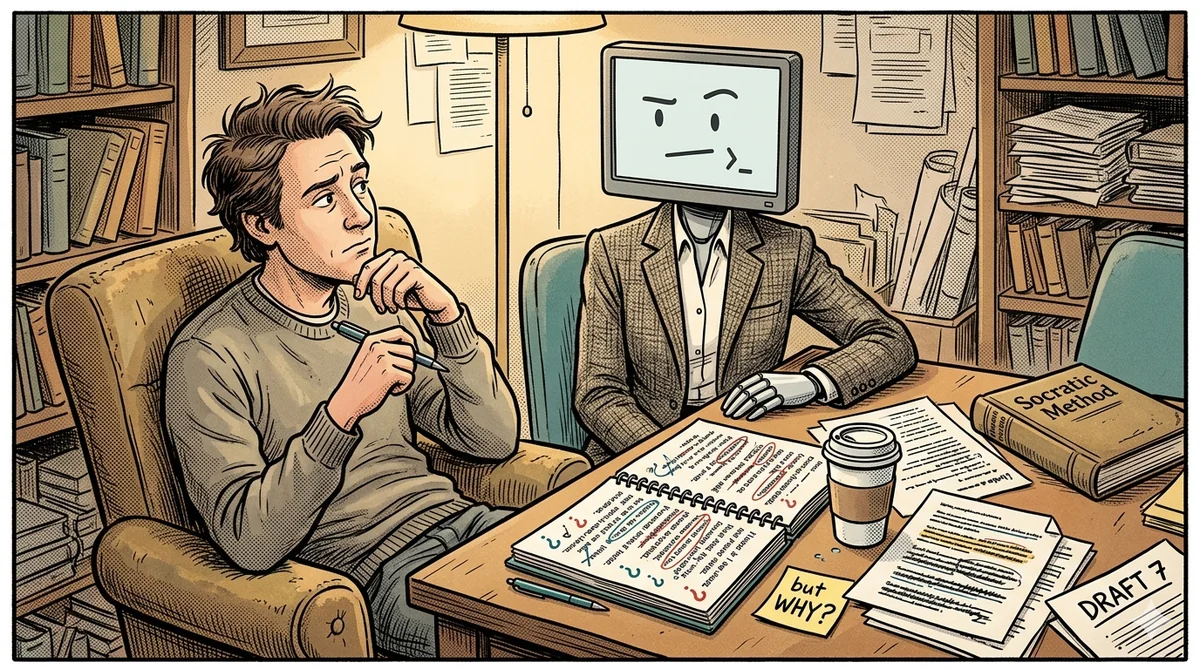
Ask AI to write your business strategy. You'll get something back in seconds - polished paragraphs, crisp structure, sensible frameworks. It will look exactly like a business strategy.
It will also be completely useless.
Not because AI is bad. Because the real work - the drilling, the questioning, the figuring out what actually matters - hasn't happened yet. You handed over a question and got back an average answer. It took nothing from you, so it gave you nothing real.
Why would software be any different? Or articles? Or product ideas?
What AI actually produces
Here's the mechanism: an LLM predicts the most probable next word, then the next, then the next. By design, it generates what's typical. What fits the statistical middle.
That's not always a problem. I'm not a native English speaker. Without AI, this article wouldn't read as clearly to an English audience. I'm also not a designer - every page and stylesheet on my website was built with AI, guided entirely by my vision. I described what I wanted, challenged what it generated, refined it. The AI handled execution. I handled direction.
Honest about it though: if I'd had access to a skilled designer who understood my vision and cared about the outcome, the website would be better. And if I'd had a real coach available, this thinking would be sharper. But I didn't have those people. So AI-amplified-by-my-judgment was better than nothing. And actually quite good.
That's the real promise of AI - not replacement. Access. An expert collaborator available to anyone, at any hour, at almost no cost.
But access to what, exactly? That's where most people go wrong.
The further away, the simpler it looks
"We can replace the developers with AI." "We don't need strategists anymore." "Just prompt it and you have a product."
This thinking comes from distance. The further you are from a problem, the simpler it looks. Software, strategy, design - from the outside, it looks like the output. From the inside, you know what actually generates it: judgment, context, taste, and years of domain knowledge that's almost impossible to articulate in a single prompt.
Here's the test: do you think your own job could be replaced by AI? If the answer is no - and it probably is - ask yourself why you think other people's work is simpler. What makes their expertise less real than yours?
AI doesn't have an answer. It has an average. And average doesn't know what matters in your specific situation, your specific market, your specific team.
Ask what it thinks of your ideas
This is the pivot that makes AI actually useful.
Don't ask it what you should do. Ask it what it thinks of what you're proposing.
Great ideas don't emerge fully formed. They emerge through dialogue - someone proposes, someone pushes back, you defend your thinking, you refine, you come at it from a different angle. Each cycle sharpens the idea. Most people don't have a good thinking partner readily available for that. You can't challenge your own blindspots - that's what makes them blindspots.
This is where AI comes into its own. Not as an answer machine. As a skeptic in the room.
Think about what even a mediocre coach does: they ask hard questions, they don't let you hide in vague language, they make you say precisely what you mean. You don't need a brilliant coach for that kind of conversation to be useful. You just need someone who won't simply agree with you.
AI can play that role - but only if you ask it to. Left to its defaults, it will validate you. It's trained to be helpful and agreeable. You have to explicitly override that. And you have to bring the domain knowledge. AI doesn't know your market, your team, your constraints, your history. You do. The combination - your expertise, AI's relentless questioning - is where the real iteration happens.
More voices heard
There are people with real insights, real experience, real ideas - who are stuck in their heads. Not because what they have to say isn't worth hearing. Because the toolkit to say it has always felt out of reach. Not everyone is a skilled writer. Not everyone knows how to design. Not everyone can articulate a product vision clearly enough to get engineers behind it.
AI changes that equation. You bring the insight. You bring the judgment. You bring the vision. AI handles the execution, shaped by your direction.
That's not just useful for CTOs and product leaders. It's useful for anyone who has something real to say but hasn't had the means to say it clearly. More ideas surfaced. More thinking made visible. More people able to contribute what only they can contribute.
The condition that doesn't change: you have to have something worth amplifying. Bring a generic question and you get a generic answer. Bring genuine thinking, genuine stakes, genuine domain expertise - and AI can help you sharpen it into something you couldn't have made alone.
Try it
Set your AI to voice conversation mode on your phone. Read the prompt below to it - or paste it in text first - then go for a walk and think out loud about something you're actually working on right now. A product idea. An article. A business proposal. A strategy. A workshop. Make it something real.
Every time I've done this I come home with clearer thinking, better overview, new ideas, and a first draft I can actually work with.
Here's the prompt:
You are a thinking partner and critical coach. Your role is not to generate ideas or answers - your role is to ask hard questions, challenge assumptions, and help me sharpen my thinking through dialogue.

During our conversation: don't agree with me just to be helpful. When I describe an idea, ask: "What's the assumption underneath that? How do you know that's true? What could go wrong?" Take on different personas when useful - skeptical analyst, customer advocate, domain specialist - and interrogate my ideas from angles I haven't considered. Stay skeptical even if I sound confident. Never let me settle for vague.

At the end of our session: summarize everything we discussed, extract all useful ideas, insights, and any draft outputs we created, and save it as a clean markdown file I can use as the starting point for a new session.
That's it. Start talking.
The magic isn't in the finished output from a single prompt. It's in the conversations. The iteration. The relentless questioning. That's where humans and AI actually work together.