 Bo Frese
Agentic AI Development
in Practice
What it takes to use AI on a codebase that matters. One day, hands-on, for experienced developers who are ready for the next step.
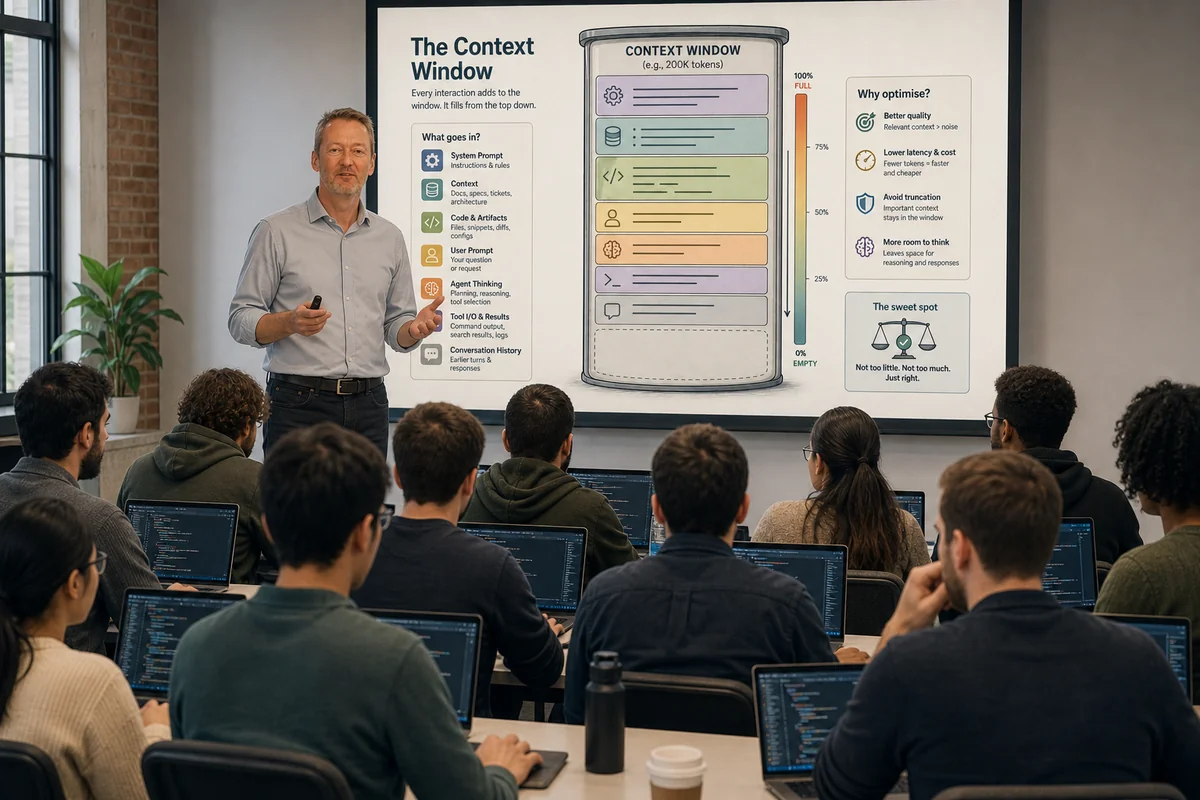
Image created with AI - obviously :-)
What this course is about
What happens when you let AI loose on your real codebase, with your actual architecture and an AI that acts across dozens of files and hundreds of decisions?
That's what this course is about: moving from chatting and vibe coding to a disciplined agentic development process, where you keep ownership of the code and can take responsibility for it. We use Claude Code as the example tool, but the same principles apply to GitHub Copilot, OpenAI Codex and most other agentic tools that run on your own machine.
You leave with something you've built, a clear method, and the tools to build the frameworks your organisation needs.
What you will learn
After the course, you will be able to:
- Set up an agentic AI development tool and use it professionally, beyond experiments
- Design and structure context so AI solves the right problem the right way
- Build your own skills and commands tailored to your workflow and technical context
- Use AI as a thinking partner from vision and requirements to finished code
- Establish a test and review discipline that keeps a human accountable for the code
You don't take home a list of prompts to copy. You take home a way of thinking, and adapt it to your own context.
— Bo Frese
Course programme
Five modules, alternating between teaching, demo, and hands-on exercises. The day is structured so each module builds on the last.
- Module 1: What changes when AI touches your codebase? The right mental model. An agentic AI tool isn't a chat window. It's an agent acting on its own across many steps. Risk, responsibility, and why vibe coding doesn't scale on professional projects.
- Module 2: Context engineering The most underrated discipline in AI-assisted development. CLAUDE.md and its equivalents, context architecture, and why different tasks need different context. A walkthrough of a complete professional toolkit.
- Module 3: AI as thinking partner From vision and business model to requirements, architecture, and design. How to get honest answers instead of confirmation. Prompt design that invites criticism and surfaces blind spots.
- Module 4: Code quality and review discipline When AI writes the code, you need to think differently about testing and review. BDD over implementation tests. And how to stay part of the process, so you understand and own code you didn't type yourself.
- Module 5: Building the framework for your organisation From personal toolkit to team standard. Custom commands that reflect your methodology and context. Warning signs. The quality conversations your organisation needs to have before scaling AI use.
Practical information
Format: One day (9:00–17:00), with teaching and hands-on exercises alternating. Available in Danish and English.
Delivery: Primarily as in-house training at your premises. Content and focus can be aligned to your technological context, adjusted in length, or combined into a longer programme.
Who it's for: Experienced software developers, mid-level and up. This course isn't about learning to code. It's about learning to work with AI as a professional development partner.
What to bring: A laptop with your agentic AI tool installed and ready, and a small hobby or side project to work on during the exercises. A Claude Pro subscription is probably enough. The course alternates between theory, demo and hands-on work, so you won't be burning tokens all day.
About the instructor
I'm a software developer with 35 years of experience, as a developer, architect, team lead, startup founder and product owner. I still build products today.
More than a year and a half of intensive AI-assisted development has changed how I work, and it has shown me what goes wrong when organisations are seduced by how convincing AI output looks. This course draws directly on that: what happened when I built my own process from scratch, and what I'd do differently.
In the end, it's developers who have to stand behind the quality of what gets built. That's what this course is about.